Chapter 1
Introduction
This lecture begins by contrasting deep learning against classical machine learning and related fields. It then gives a very quick tour of problems in certain influential application areas. The lecture ends by discussing how data is represented and processed within deep learning systems, namely, via the tensor data structure and review of basic linear algebra operations. It is assumed the material in this lecture is mostly review and that most students would have seen it before.
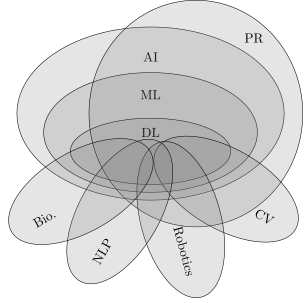
Let us begin by positioning the field of deep learning within the broader scientific discipline of artificial intelligence (AI). Figure 2 provides a good illustration. We can loosely define AI as being about building machines that behave in an intelligent way. Machine learning (ML) is a sub-field of AI where the machines that we build improve their performance on some task by learning from data or with gained experience. Deep learning (DL) then is a sub-field of machine learning where the models that make up these machines—often called neural networks—are learned in an end-to-end fashion (i.e., with limited human engineering of features or model architectures).1 A large part of AI involves pattern recognition (PR), which is an older term that relates mostly to perception and prediction versus action and planning, another large part of AI. Not shown in the diagram are the mathematical and computer science foundations upon which deep learning is based—primarily, linear algebra, probability, calculus, optimisation, programming, algorithms, and data science. This course assumes that you have a basic understanding of these foundation topics, some of which will be reviewed briefly at the end of the lecture.
This course studies deep learning with a focus on certain application areas such as computer vision and natural language processing that have heavily influenced the models and methods in deep learning. In turn, these application areas have gained enormously from the results that deep learning has delivered. Computer vision (CV) is about developing algorithms for machines to understand the world behind images and videos. Some people think of this as inverse graphics. Natural language processing (NLP) studies the structure of language and develops algorithms for extracting information from language—both written and spoken. It enables machines to engage with humans in a natural way. We will discuss various problems studied in both CV and NLP later in the lecture.
It is important to note that there are many areas in computer vision and natural language processing that are not related to deep learning, for example, how cameras capture images of the world or the semantic and syntactic structure of language. Computer vision and natural language processing are still very much their own independent research fields. Likewise, there are many other application areas that have contributed to and benefited from deep learning. The most notable of these are robotics, bioinformatics, scientific discovery, and medicine.
Carl Sagan, the famous astronomer and science educator, once said, “You have to know the past to understand the present.” We can pinpoint a precise moment in time when deep learning became a viable and popular research field. Although research into neural networks can be traced back to the 1960s [88, 105], it wasn’t until 2012 where ideas from the past were put into a system that was truly competitive with other techniques for solving problems in computer vision—and shortly afterwards natural language processing—and the field that we call deep learning was born. Roughly speaking, research and methods in machine learning and its applications prior to 2012 were characterized by theory and provable algorithms. Systems involved a lot of feature engineering to get to work. Post 2012, deep learning methods have been characterized by data and compute, and building systems with end-to-end composeability. It is still not easy to get systems to work reliably all the time. But, as we will see, the knobs that we get to tune are different to the feature engineering of the past.
While deep learning is the dominant approach to solving problems in computer vision and natural language processing nowadays, it is important to mention that many classical ideas are still very relevant, either in their influence on deep learning techniques, in their adoption as components within larger deep learning systems, or as standalone algorithms. Moreover, developing theories and principles to better understand the behaviour and reliability of deep learning systems is becoming more and more urgent as deep learning algorithms are deployed in real-world engineering, economic, environmental, educational, societal, and health applications.
So what happened in 2012? A few years prior to 2012 a group of researchers from Stanford University led by Fei-Fei Li collected a massive dataset of images from the web (over one million). Each image in the dataset was annotated with a label that described its content employing the help of crowd-sourcing. There were images of dogs and cats of various breeds, cars, airplanes, foods, etc. One thousand different categories in total. The dataset was called ImageNet [21]. It was and remains one of the largest datasets of it’s kind. To go along with the dataset, the Stanford group started the ImageNet large-scale visual recognition challenge (ILSVRC), where researchers from around the world could compete on who had the best image recognition algorithm, that is, whose algorithm would correctly recognise the most number of images in a hold-out test set. In 2012, Alex Krizhevsky, a graduate student of Geoffrey Hinton from the University of Toronto, entered the challenge with a deep learning based model [61]. It significantly beat all other models. This was a watershed moment for deep learning. The following year the top five performing entries were based on deep learning. The year after that, and every year since, all entries used deep learning and the error rate steadily dropped. Today deep learning outperforms humans on the ILSVRC challenge.
Since 2012 progress has continued to accelerate thanks various initiatives and proven effectiveness across a large number of application domains. First, the development and support of high-quality open-source software libraries (supported by industry) such as PyTorch [80], TensorFlow [1] and JAX [11], has made it easy to develop models and reproduce results from other researchers. Second, the availability of large and diverse datasets necessary to train models. Third, the existence of fast and cheap compute such as GPUs for accelerating the core calculations used in deep learning models.2 Third, a growing community of researchers and engineers that facilitate the rapid sharing of knowledge, ideas, and results. And last, the amazing success of recent large language models (such as ChatGPT in 2022, and Gemini, Claude and DeepSeek that followed) and deep learning tools for image and video generation has attracted significant private and public investment in AI commercialisation and supporting infrastructure.